Description
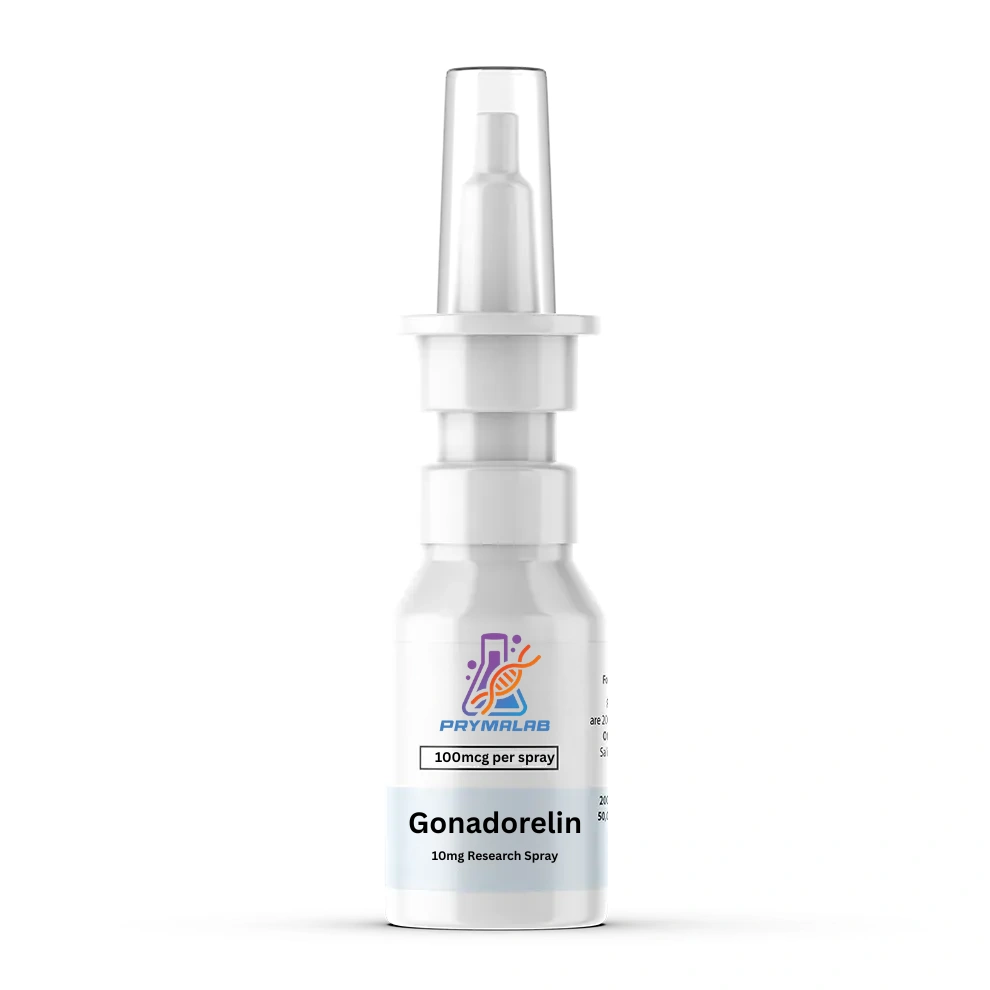
This gonadorelin nasal spray supplies gonadorelin, a synthetic decapeptide chemically identical to endogenous gonadotropin-releasing hormone. The sequence is pGlu-His-Trp-Ser-Tyr-Gly-Leu-Arg-Pro-Gly-NH2, molecular formula C55H75N17O13, molecular weight 1182.29 Da, CAS 33515-09-2. It is also called GnRH or LHRH in the literature. Unlike the engineered analogs, nothing here has been modified for stability, and that is the point of using it. Supplied strictly for laboratory research use only.
The clinical uses of this molecule, and what is sold here
Because gonadorelin is chemically identical to the endogenous hormone, it has a genuine clinical history, and that needs separating from a research listing.
Its main established role has been as a diagnostic agent. In the GnRH stimulation test, a dose is given and the pituitary response measured, which distinguishes a hypothalamic problem from a pituitary one in the investigation of delayed puberty, hypothalamic amenorrhea and hypogonadotropic hypogonadism. It has been marketed for that purpose as Factrel, and as Lutrepulse for pulsatile delivery through a portable infusion pump, since reproducing the natural rhythm requires an infusion pump rather than a single dose. As a fertility medicine it follows the same logic, using pulsatile stimulation to restore ovulation where the hypothalamic signal is absent, which places it among the treatments for infertility of hypothalamic origin. Reproductive disorders of that kind are diagnosed rather than assumed, and gonadorelin acetate is the salt form usually supplied. A veterinary product, Gonabreed, uses the same molecule for oestrus synchronisation in livestock.
Related compounds behave differently. A GnRH agonist engineered for stability, meaning a GnRH analogue such as buserelin or triptorelin, produces suppression rather than stimulation on continuous exposure, which is why that group is used in endometriosis, in prostate cancer and in some breast cancer protocols, with reduced bone density as a recognised consequence of prolonged suppression. Abdominal discomfort is among the reported effects across this class. This is a synthetic decapeptide either way, but the pharmacology diverges completely depending on whether exposure is pulsed or continuous.
There is also a use pattern worth naming directly. Gonadorelin circulates in discussion around testosterone replacement therapy, usually shortened to TRT, on the argument that exogenous testosterone suppresses the axis and causes testicular atrophy, sometimes described as testicular shrinkage, with human chorionic gonadotropin, HCG, used for the same purpose. Framing it as hormone therapy, as a route to hormonal balance, or as a correction for hormonal imbalances places it in a prescription context that requires a clinician, monitoring and a diagnosis. It is not a supplement, it is not peptide therapy, and it has nothing to do with unrelated compounds such as yohimbine that appear in the same marketing. Questions about sexual desire, reproductive health or declining reproductive functions belong in that consultation too. Nothing on this page supports that use, and testosterone production, sperm production and spermatogenesis are described here only as physiology. This is a synthetic peptide sold as a research chemical, and that is the whole of what it is.
Gonadorelin and triptorelin are not the same compound
This needs correcting because it is repeated on vendor pages and even turns up in reference material. Gonadorelin and triptorelin are different molecules.
Gonadorelin is native GnRH, carrying glycine at position 6. Triptorelin substitutes D-tryptophan at that position. One residue, one stereochemical change, and the consequences are large: gonadorelin has a reported half-life of 2 to 10 minutes, while triptorelin resists the endopeptidases that clear the native peptide and persists for hours with roughly 100-fold greater potency.
Anything that treats the two names as synonyms is wrong, and if you are reading a source that does, treat the rest of its pharmacology with suspicion. For a research program the distinction is the entire reason you would choose one over the other: gonadorelin is the tool for studying physiological GnRH signalling, and a superagonist is the tool for studying receptor desensitization.
The pharmacology is in the timing, not the dose
The short half-life is usually described as a limitation. In a research context it is the feature.
The GnRH receptor reads pulses. Physiologically the hypothalamus releases GnRH in discrete bursts roughly every 60 to 120 minutes, travelling to the anterior pituitary gland where GnRH receptors, written GnRHR or as the gonadotropin-releasing hormone receptor, sit on gonadotroph cells. Their response is to release luteinizing hormone and follicle-stimulating hormone, and those two gonadotropins act on the gonads to drive steroid output including progesterone, with Sertoli cells responding to FSH on the male side. That loop is the hypothalamic-pituitary-gonadal axis, usually written as the hypothalamic-pituitary-gonadal (HPG) axis, and upstream of it kisspeptin neurons set the rhythm. Pituitary gland function, hormonal regulation and the hormonal signaling pathways feeding into it all hinge on that timing, and the pattern rather than the average concentration determines the downstream response. Deliver GnRH in pulses and gonadotropin output is sustained. Deliver the same total amount continuously and the receptor internalizes, surface expression falls, signalling desensitizes and output is suppressed. Same receptor, same agonist, opposite outcome, decided by temporal pattern alone.
Gonadorelin’s rapid clearance is what makes pulsatile study possible, because a peptide that lingers cannot produce a trough. That is why it, rather than a stabilized analog, is the appropriate reagent for asking questions about frequency-dependent signalling. It is also a warning about experimental design: leaving native GnRH in a static culture well for hours is not modelling physiological stimulation, it is modelling continuous exposure, which is the desensitizing condition. Perfusion systems and repeated pulse-and-wash protocols exist precisely because static exposure cannot reproduce the physiological pattern.
In-vitro models and readouts
The GnRH receptor is a Gq-coupled class A GPCR, so inositol phosphate accumulation and intracellular calcium mobilization are the direct readouts. Recombinant lines expressing human GnRH receptor suit receptor-level pharmacology, while primary pituitary cultures and gonadotroph-derived lines are used where gonadotropin secretion itself is the endpoint, measured as LH and FSH by immunoassay.
On format and paperwork: this material may be listed elsewhere as a gonadorelin peptide vial or as a gonadorelin pre-mixed peptide, and lyophilized presentations require reconstitution before use, which is a step worth recording in your methods. Delivery language around intranasal administration and the nasal mucosa, or comparisons against subcutaneous injection, describes routes into an organism and has no bearing on a culture experiment. Any gonadorelin research you design should treat this as what it is, a research chemical.
Two design points for intranasal gonadorelin research and in-vitro work with this peptide specifically. First, protease activity in your system will consume the peptide quickly, so serum-containing medium over a long incubation gives a falling and poorly defined exposure. Second, because pulse frequency is the independent variable in much of this biology, an experiment that varies concentration while holding exposure continuous is answering a different question from the one usually intended. Recording the exposure pattern with the same care as the concentration is what makes results comparable across laboratories.
Gonadorelin nasal spray specifications
Core identity data for this gonadorelin nasal spray. Quote the sequence and CAS number in your methods section, and state the exposure pattern rather than concentration alone.
| Compound |
Gonadorelin, native gonadotropin-releasing hormone |
| Also known as |
GnRH; LHRH |
| Sequence |
pGlu-His-Trp-Ser-Tyr-Gly-Leu-Arg-Pro-Gly-NH2 |
| Relationship to endogenous GnRH |
Chemically identical; no stabilizing modification |
| Molecular formula |
C55H75N17O13 |
| Molecular weight |
1182.29 Da |
| CAS number |
33515-09-2 |
| Termini |
N-terminal pyroglutamate; C-terminal glycinamide |
| Reported half-life |
2 to 10 minutes |
| Receptor |
GnRH receptor (GnRHR), Gq-coupled class A GPCR |
| Key variable |
Exposure pattern: pulsatile stimulates, continuous desensitizes |
| Format |
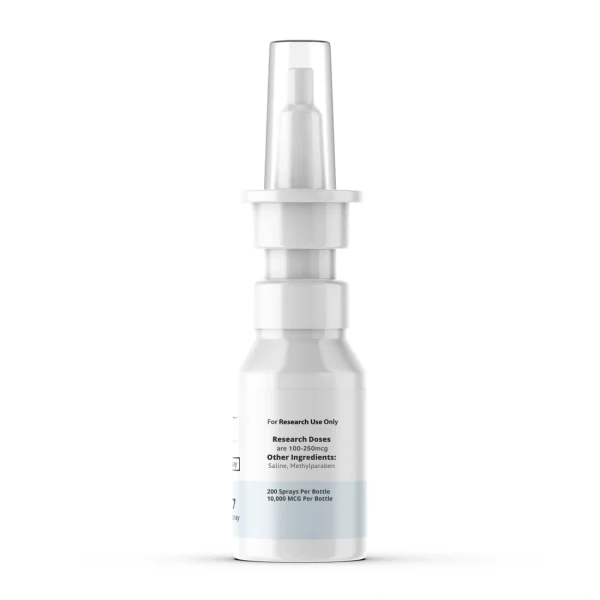
Metered spray bottle [CONFIRM: fill volume, mg per bottle, concentration] |
| Classification |
Research chemical. In-vitro laboratory use only. Not for human or veterinary use. |
Gonadorelin nasal spray storage and handling
The terminal modifications help. A pyroglutamate at the N-terminus and a glycinamide at the C-terminus block the exopeptidase routes that degrade many linear peptides, so the dry material is reasonably stable. The vulnerability is elsewhere.
Tryptophan at position 3 is the residue to protect. It is among the most light-sensitive and oxidation-prone amino acids, so keeping this material out of light is a specific requirement rather than boilerplate. Use amber or foil-covered containers, keep bench time short, and discard solution that has discoloured.
In solution the peptide is exposed to endopeptidase cleavage at the internal bonds the terminal caps do not protect, which is the whole reason its biological half-life is minutes. That has no bearing on a sealed vial in a freezer, but it governs behaviour the moment the peptide meets a biological matrix. Sound gonadorelin nasal spray storage is otherwise routine: cold, sealed, single-use aliquots rather than repeated freeze-thaw, and low-binding plasticware at low working concentrations.
How research grade gonadorelin spray is characterized
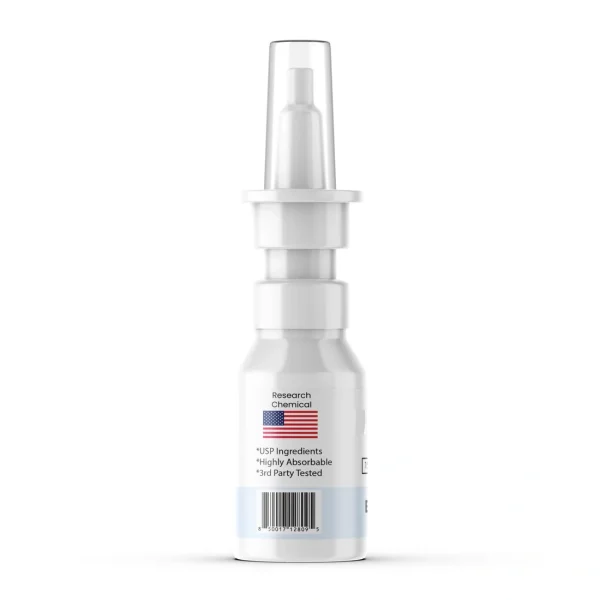
Because gonadorelin is the unmodified native sequence, verification is more straightforward than for an analog: there is no D-amino acid whose configuration mass spectrometry cannot resolve. Reversed-phase HPLC establishes purity and mass spectrometry confirms identity at 1182.29 Da, and the two terminal modifications, pyroglutamate and glycinamide, are both worth confirming because an uncyclized N-terminal glutamine or a C-terminal free acid would each shift the mass and change behaviour. A research grade gonadorelin spray is supplied under the same verification PrymaLab applies across its research peptides, HPLC and MS confirmation plus independent third-party testing. No specific lot figures are asserted here; request the certificate of analysis for the lot you receive.
For related research compounds, see the PrymaLab Research Library.
Frequently asked questions
What is gonadorelin?
Gonadorelin is a synthetic decapeptide chemically identical to endogenous gonadotropin-releasing hormone, sequence pGlu-His-Trp-Ser-Tyr-Gly-Leu-Arg-Pro-Gly-NH2, 1182.29 Da, CAS 33515-09-2. It is also called GnRH or LHRH. Material supplied here is a research chemical for in-vitro laboratory use only.
Is gonadorelin the same as triptorelin?
No, and sources that say so are wrong. Gonadorelin is native GnRH with glycine at position 6. Triptorelin substitutes D-tryptophan there, which makes it protease-resistant, far longer-lived and roughly 100-fold more potent. They are different molecules with different behaviour.
Why does gonadorelin have such a short half-life?
Because it is the unmodified native sequence, so endopeptidases cleave it at internal bonds the terminal pyroglutamate and glycinamide do not protect. Reported half-life is 2 to 10 minutes. In research terms that rapid clearance is what makes pulsatile stimulation possible to model.
Why does pulse pattern matter more than concentration?
Because the GnRH receptor responds to the rhythm of stimulation. Pulsatile exposure sustains gonadotropin output; continuous exposure of the same total amount causes receptor internalization and desensitization. Static culture exposure over hours models the continuous, suppressive condition rather than physiological stimulation.
Is gonadorelin nasal spray approved for human use?
No. This material is a research chemical for in-vitro laboratory use only and is not intended for human or veterinary use. Gonadorelin exists as a prescription medicine in other contexts, which has no bearing on research-chemical material. Nothing here is medical advice.
Ordering and compliance
Every PrymaLab research compound ships from the United States and is sold research-use-only. This gonadorelin nasal spray is supplied for in-vitro laboratory research, is not intended for human or veterinary use, is not a drug, supplement or sports product, and has not been evaluated by the FDA for the research-chemical context. Verify the legal status of any research compound in your jurisdiction before ordering, and note that GnRH peptides are prescription medicines in many jurisdictions. Certificates of analysis are available on request for the lot you receive.











Reviews
There are no reviews yet.